
Learning Management Systems (LMS) are widely used in education and professional training to organise courses, deliver learning materials and monitor student progress.
From coaching institutes managing multiple batches to businesses providing employee training, LMS platforms support different learning requirements.
Understanding the different types, benefits and practical applications can help institutions choose a platform that suits their needs.
Types of Learning Management Systems
LMS platforms serve different purposes depending on the organisation and its training requirements.
Academic LMS
Schools, colleges and universities use academic learning management systems to organise coursework, share study materials, collect assignments and monitor student participation.
Corporate LMS
Businesses use LMS platforms for employee onboarding, skill development and workplace training. These systems help organisations deliver consistent training across different teams and locations.
Cloud-Based LMS
A cloud-based LMS allows students and instructors to access courses through the internet without maintaining the software on their own servers.
It is particularly useful for institutions offering online or hybrid learning.
Coaching Institute LMS
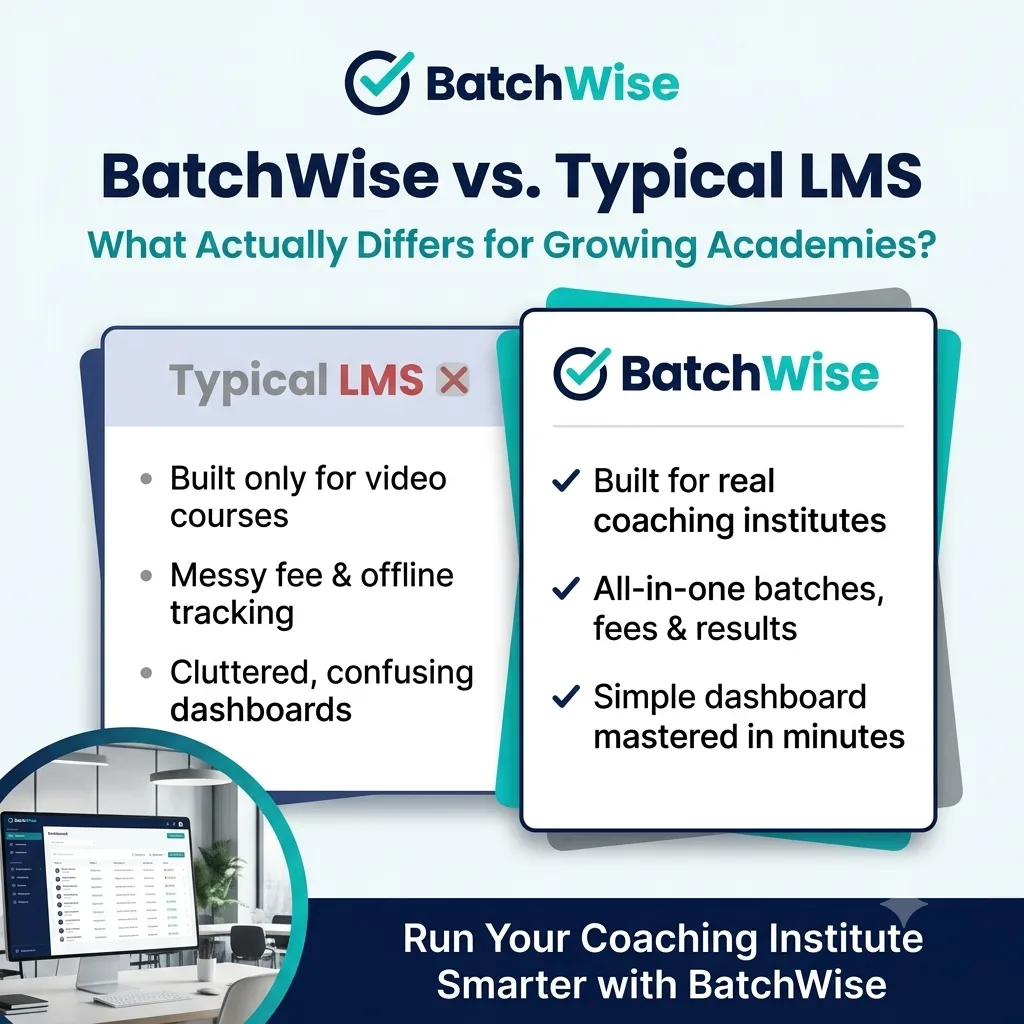
Coaching institutes require tools that support their daily teaching activities, including batch scheduling, course management and student assessments.
A dedicated LMS can help institutes coordinate these activities as their student numbers increase.
These categories can overlap. For example, an academic or coaching institute LMS may also be cloud-based.
Benefits of Using an LMS
A Learning Management System offers several practical advantages for institutions managing courses and students.
Better Course Organisation
Lessons, assignments and study materials can be arranged in a structured format. This makes it easier for students to find resources and helps instructors keep course content consistent across batches.
Flexible Learning Access
Students can access learning materials from different locations. Platforms supporting recorded lessons also allow them to revisit topics and revise at their own pace.
Reduced Administrative Work
Digital attendance records, assessment management and course scheduling can reduce repetitive manual tasks, giving instructors more time to focus on teaching.
Improved Student Progress Tracking
Assessment results and learning reports help instructors understand student performance. They can identify students who need additional guidance and adjust their teaching accordingly.
Easier Management as Institutions Grow
As institutions introduce new courses or increase enrolments, an LMS helps maintain organised learning records and processes without relying on multiple disconnected tools.
Practical Applications of LMS Software
Learning management systems are used across different educational and training environments.
- Competitive Exam Coaching: Institutes can provide subject-wise lessons, conduct mock tests and monitor student performance.
- Online Tutoring: Independent tutors can organise virtual sessions, share study materials and manage assignments.
- Skill Development Programmes: Training centres can deliver structured courses and track learning progress.
- Hybrid Learning: Institutions combining classroom teaching with online education can make course materials and assessments accessible through one platform.
LMS Software for Coaching Institutes
Consider a coaching academy offering the same competitive exam course across three batches.
The syllabus may be identical, but class timings, attendance and assessment results will differ for each group.
Without an organised system, instructors may spend additional time updating records and sharing the same materials repeatedly.
An LMS allows the academy to maintain common learning resources while managing each batch's activities separately.
This helps instructors maintain consistency without losing track of individual student groups.
Supporting Academy Management with Batchwise
Batchwise is a learning and academy management platform designed for coaching institutes, tutors and training academies.
Its Course Builder helps instructors organise lessons and learning resources, while Live Classes supports online teaching.
The platform also includes Smart Attendance for maintaining attendance records and a Quiz Builder for creating assessments.
These tools help institutes manage important teaching activities through a more connected workflow.
Choosing an LMS That Fits Your Institution
The right LMS depends on your teaching methods, student capacity and operational needs.
A coaching institute may prioritise batch management and assessments, while a professional training centre may need self-paced courses and completion tracking.
Before selecting a platform, consider its ease of use, scalability, available support and suitability for your existing processes.
An LMS should make managing education simpler, not introduce unnecessary complications.
Explore Batchwise to find out how its learning and academy management tools can support your institution.